Australian Standards for Urine Drug Testing: AS/NZS 4308:2023 Guide
There’s a deadline approaching that many Australian employers don’t yet know about, and those who miss it will find themselves in a very uncomfortable position.
By November 2026, every workplace urine drug testing programme in Australia will need to meet the updated requirements under the AS/NZS 4308:2023. The standard is officially called: Procedures for Specimen Collection and the Detection and Quantification of Drugs in Urine.
It doesn’t matter whether the workplace runs mining operations in Western Australia, a logistics fleet in Queensland or a construction site in Victoria. Drug testing compliance in Australia just got a significant update and understanding what has changed isn’t exactly optional anymore.
This guide helps to break it all down.
What Changed from AS/NZS 4308:2008 to 2023
The AS/NZS 4308 standard had been around since 1995, originally published as AS 4308-1995 and Australian workplaces built their drug-testing programmes around it. In 2001, it was revised and jointly designated as AS/NZS 4308:2001. In 2008, it was updated as AS/NZS 4308:2008, which introduced provisions for on-site screening. In 2023, the standard was updated to AS/NZS 4308:2023. It included a 36-month rollover period before the 2008 standard was to be superseded. This gives everyone involved in the process time to update policies, procedures and products.
The AS/NZS 4308:2023 standard enhances workplace drug testing by lowering cut-off levels for cocaine and updating reporting terminology to “not-negative.” Science has moved forward, substances have evolved and the 2008 standard simply couldn’t keep pace with what employers were actually dealing with on-site, in the real world.
The 2023 revision, however, brought the standard into the modern era across several key areas:
The scope of substances screened for was only slightly altered (with only cocaine changing). The updated standard now better accounts for the realities of contemporary drug use with some of the key findings below:
- There is a whole new appendix dedicated to Additional and optional testing – Appendix A, which covers Additional and optional testing, including setting a cut-off level for Oxycodone if it is included in a screening test.
- Cut-off levels for specific drugs and compounds, depending if you are using:
-
- immunoassay – a biochemical test that measures the presence or concentration of a substance (analyte), including drugs, in biological samples using the specific binding between an antigen and an antibody
or - mass-spec screening – a highly specific analytical technique used to detect and quantify compounds, such as drugs, by sorting ions based on their mass-to-charge ratio.
- immunoassay – a biochemical test that measures the presence or concentration of a substance (analyte), including drugs, in biological samples using the specific binding between an antigen and an antibody
- It also gives a list of examples of drugs that can be tested for in consultation with a lab, such as Fentanyl and Synthetic Cannabinoids.
Collector training and competency requirements also saw meaningful updates. The standard places a strong emphasis on the qualifications of the people who are actually administering collections, not just on the labs that process the samples. That’s a change that matters a lot for employers who are increasingly relying on on-site testing programmes.
Point-of-care testing devices (such as rapid on-site screening kits) are addressed with greater specificity than before. The criteria for acceptable devices, their proper use and the handling of results have all been clarified. This should be genuinely helpful for anyone trying to run a compliant on-site programme.
Stronger Quality Control Requirements for On-Site Testing
One of the biggest operational changes introduced in AS/NZS 4308:2023 is the increased emphasis on quality control for on-site urine drug screening.
Under the previous 2008 standard, much of the quality assurance focus sat with accredited laboratories. The 2023 standard places greater responsibility on organisations that conduct workplace testing themselves by introducing defined quality-control procedures for on-site screening devices and for creatinine measurement.
This means employers can no longer simply purchase compliant urine drug testing devices and assume they remain compliant throughout their shelf life.
The testing programme itself must demonstrate that devices continue to perform as intended. The new quality control requirements include:
- High-and low-control samples must be tested before a new lot of on-site drug-screening or creatinine-testing devices is put into service.
- Ongoing high- and low-control testing must then be performed at least monthly for every lot of devices held in storage.
- All quality control results must be documented and retained as part of the organisation’s quality records.
- If a control test fails, the affected lot must be investigated and, where necessary, withdrawn from service until satisfactory performance has been demonstrated.
- Organisations must also have documented procedures describing how quality control failures are managed and how the integrity of previous test results will be assessed if a failure occurs.
The standard also encourages participation in ongoing proficiency or blind testing programmes. These independently verify that collectors, devices and on-site testing processes continue to produce reliable and repeatable results over time rather than simply relying on manufacturer specifications.
For employers running their own workplace testing programme, this represents a significant shift. Compliance is no longer just about using the right urine cup or following the correct collection procedure. It now includes maintaining documented evidence that the testing devices themselves continue to perform accurately throughout their use.
New Cut-Off Levels and Detection Windows
Cut-off levels are the concentration thresholds that determine whether a sample returns a not-negative or negative result. Get them wrong (or use outdated thresholds) and the whole testing programme is built on shaky ground.
AS/NZS 4308:2023 has seen the following key changes implemented:
Key Changes in Cut-offs (2008 vs. 2023):
- Cocaine Metabolites: Screening reduced from 300 ng/mL to 150 ng/mL. Confirmation dropped from 150 ng/mL to 100 ng/mL.
- Benzodiazepines: Screening remains at 200 ng/mL, but the confirmation cut-off for metabolites (Nordiazepam, Oxazepam, Temazepam) has been revised to improve accuracy and reduce false positives.
- Opiates, Amphetamines and THC: Cut-off levels for these substances remain consistent with the 2008 standard.
These changes across the substance classes are to better align with both current pharmacological understanding and international best practice. This matters in practice because a test calibrated to old thresholds might clear someone who shouldn’t be cleared or flag someone who shouldn’t be flagged.
Cannabis remains the most commonly detected substance in Australian workplace urine testing. Detection windows vary based on factors such as frequency of use, body composition, and the type of specimen collected. On that last note, urine is the most common specimen.
For amphetamines (including methamphetamine), the cut-off levels have not changed. The standard specifically states that it applies only to exposure, not to impairment.
Cocaine and some specific analytes for other drug classes have updated cut-off levels under the 2023 standard. If you want to test for compounds outside the ‘standard six’ (opiates, amphetamines, methamphetamine, cocaine, benzos & THC), you can use extended panel testing, such as a dip test; however, the standard notes that it should be done in consultation with a laboratory that can provide advice on what levels are consistent or inconsistent.
Any testing programme still operating off 2008 cut-off numbers needs to be updated immediately.
Not in November 2026, but now.
What is Creatinine?
Creatinine is a naturally occurring chemical waste product generated by muscle metabolism and filtered exclusively by the kidneys, which excrete it into urine. In a healthy human body, muscle mass and kidney function remain relatively stable day-to-day, so creatinine concentrations in normal urine remain within a highly predictable, consistent baseline range.
Why is it a Critical Focus in Workplace Drug Testing?
In the context of workplace drug screening, creatinine is not tracked to detect substance abuse; instead, it is utilised as the ultimate gauge of sample validity and donor integrity.
Because it is an unavoidable biological signature of human urine, tracking creatinine allows testing officers to immediately identify if a donor is attempting to cheat or tamper with the test.
Testing panels look for two major red flags:
- The Absence of Creatinine (Low Readings): An abnormally low or completely absent creatinine reading indicates that the sample is not a natural human specimen. It instantly flags that the donor has either substituted their sample with synthetic “fake urine” or has consumed extreme volumes of water to flush and dilute their system below the readable drug thresholds.
- Spiked Concentrations (High Readings): Conversely, an unnaturally elevated or concentrated creatinine reading suggests that it might be a heavily diluted or altered sample.
The AS/NZS 4308:2023 Enforcement
While modern urine cups utilise a matrix of integrity checks – including pH scales, specific gravity, and temperature strips (which have been expanded under the 2023 standard to read from 32°C to 38°C) – the new standard singles out creatinine for rigorous enforcement.
Under the AS/NZS 4308:2023 regulations, creatinine testing panels can no longer be passive add-ons. Manufacturers must be able to demonstrate that their devices have been independently verified as fit for purpose in accordance with Appendix B of AS/NZS 4308:2023. In addition, organisations conducting on-site testing must now perform ongoing high and low creatinine quality control testing to verify continued device performance.
Chain of Custody Requirements
Chain of custody is where a lot of well-intentioned drug testing programmes quietly fall apart. It sounds like a legal formality, but it’s actually the backbone of any defensible result.
If a positive test ever ends up in a Fair Work Commission hearing or an internal dispute process, chain-of-custody documentation is what makes or breaks the case.
AS/NZS 4308:2023 reinforces and clarifies the chain of custody requirements present in the 2008 standard, with greater specificity regarding documentation, handling and transfer procedures.
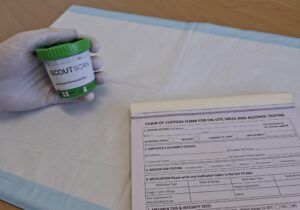
From the moment a specimen is collected, every step needs to be documented. Who collected it, when, reason for testing, unique donor identifiers, screening results (if the sample is screened), and donor acknowledgement that the sample is theirs. All of it needs to be traceable without gaps.
The standard specifies the use of tamper-evident specimen containers and requires that chain-of-custody forms accompany specimens throughout the process.
For on-site testing, chain-of-custody requirements also apply to the screening process. A not-negative screening result that isn’t properly documented and handled in accordance with the standard cannot be relied upon if challenged.
That’s a very real risk for employers who treat on-site testing as a quick, informal process rather than a documented procedure. Laboratories may also refuse to run tests on samples that do not meet the chain-of-custody protocol.
Employer Compliance Checklist
Getting compliant with AS/NZS 4308:2023 isn’t a job to put aside for an afternoon; however, it is absolutely manageable with the right roadmap.
Here’s what every employer should be working through before that November 2026 deadline:
- Review and update the workplace drug and alcohol policy: The policy needs to reference the current standard, not the 2008 version. If the document still cites AS/NZS 4308:2008, it needs to be updated.
- Audit current testing procedures against the 2023 requirements: Cut-off levels, collection procedures and documentation practices are all ways to compare what’s happening on the ground with what the standard actually requires.
- Verify laboratory accreditation: Confirming that the laboratory processing the tests holds current NATA accreditation under the updated standard is non-negotiable.
- Check the collector’s qualifications and training: The people administering collections need to meet the competency requirements outlined in the 2023 standard. Review their credentials and identify any gaps.
- Review on-site testing device compliance: If rapid on-site screening devices are part of the programme, confirm they meet the performance criteria specified in AS/NZS 4308:2023.
- Update chain-of-custody documentation: The forms, procedures and handling practices will all need to align with the current standard’s requirements.
- Train managers and supervisors: The people making reasonable-cause testing decisions need to understand what the updated standard means for their roles.
- Implement an onsite quality control programme: If your organisation conducts on-site urine drug testing, ensure routine high and low control testing, lot verification, documentation and quality control procedures comply with AS/NZS 4308:2023.
What Happens If You’re Not Compliant by the November 2026 Deadline
Here’s the uncomfortable part. A drug testing programme that doesn’t comply with AS/NZS 4308:2023 after the November 2026 deadline isn’t just technically out of date. It also creates genuine legal and operational exposure.
In safety-critical industries where drug testing is a regulatory requirement, non-compliant testing procedures can undermine the legal defensibility of results. An employee who is dismissed following a positive result from a non-compliant test has very real grounds to challenge that outcome. And, depending on the industry and jurisdiction, there may also be direct regulatory consequences for organisations whose safety management systems reference testing standards they don’t actually meet.
Beyond the legal risk, there’s a practical safety argument. The 2023 standard exists because the 2008 standard wasn’t keeping pace with the actual landscape of workplace drug use. Operating under outdated cut-offs and procedures means the testing programme may not catch what it’s supposed to. It’s not necessarily drugs at the workplace; it’s about not being at work while impaired, thereby increasing the risk of an unsafe work environment. That’s a risk that ultimately shows up as workplace incidents, not compliance notices.
The November 2026 deadline feels like it’s a long way off. It isn’t. Updating a workplace drug testing programme (and especially in a large organisation) takes time. Policy reviews, supplier conversations, staff training and documentation overhauls are each significant processes. Getting each process underway now is the move that makes the deadline feel manageable.
Leaving it for late 2026 is precisely a move that could make it feel like a crisis!
Are you ready to make sure your workplace drug testing programme meets every requirement under AS/NZS 4308:2023?
The team at Sober Check Australia are built for exactly this, walking employers through the updated standard, identifying gaps in current programmes and putting a clear path to compliance in place before the deadline arrives.
Get in touch with the team today to learn how we can help get your testing programme in place.